


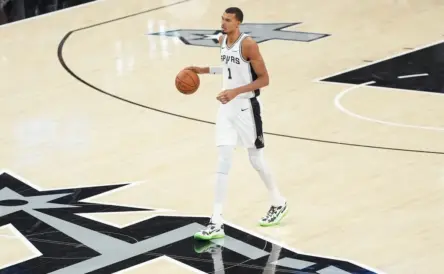
 In his third NBA season, Victor Wembanyama gave Crickex Sign Up readers a clear view of a generational talent finally turning promise into dominance. He survived an injury scare, won Defensive Player of the Year without suspense, and earned spots on both All-NBA and All-Defensive First Teams. In the regular season, he averaged career highs of 25 points and 11.5 rebounds, while his 3.1 blocks per game left the rest of the league in the dust.
His voice also grew louder. Late in the season, Wembanyama openly argued that he deserved MVP consideration over Thunder star Shai Gilgeous-Alexander, saying his defensive impact had been badly underrated. He even brought an old-school edge to the All-Star Game, turning what is often a lighthearted showcase into a fierce, physical contest.
In the playoffs, Wembanyama kept building his legend. Across three Western Conference rounds, he faced elite defensive big men, from Donovan Clingan and Rudy Gobert to Chet Holmgren, and outplayed them all. By the end of the postseason, he had scored 524 points, the most ever by any player aged 22 or younger in a single playoff run, surpassing LeBron James in 2007 and Kevin Durant in 2011.
That hunger for a championship won him countless admirers. Even NBA commissioner Adam Silver praised his curiosity, global perspective, and dedication to mastering the game. Yet once the Finals arrived, the applause began to fade. Across five bruising games against the Knicks, Wembanyama’s weaknesses were suddenly laid bare.
His averages of 26 points, 11.2 rebounds, 2.6 assists, 1 steal, and 3.6 blocks looked strong on the surface, but his efficiency told another story. He shot just 42.3 percent from the field, 27.3 percent from three, and 78.6 percent from the line, all below his regular-season level. Defensively, New York repeatedly dragged him away from the paint, reducing the fear factor that had defined his season.
He also failed to gain a real edge inside. Several careless mistakes hurt San Antonio, especially his rash late pass in Game 2, which dealt a heavy blow to a young Spurs team. Before the Finals, many optimistic fans believed Wembanyama was only inches from the mountaintop. After five games, both he and the Spurs were sent crashing back down. He later admitted the experience was painful, saying it angered him to think he might need nearly 100 more games just to return.
This season proved that his path cannot be summed up by saying the future belongs to him. His lack of strength remains a real issue. It may be hidden during the regular season or in favorable playoff matchups, but against a rock-solid Knicks team, it was impossible to ignore.
Former Knicks star Amar’e Stoudemire said Wembanyama must sharpen his interior game this offseason. He needs stronger positioning, better footwork near the lane, and more reliable use of his size. That likely means adding weight, improving lower-body strength, and following a targeted strength plan. Only then can he reach the next level.
The challenge is that his unusual frame makes added weight risky. More lifting could increase injury concerns, so the Spurs must take a gradual, medically guided approach. His shooting also needs work. In the Finals, too many rushed jumpers wasted good possessions. His handle was also disrupted too easily, meaning he should simplify his game and create quicker, cleaner shots.
Perhaps he can learn from Kevin Garnett’s smooth, practical mid-range game. Tim Duncan won a title in his first Finals appearance in 1999, but Wembanyama still trails the Spurs legend in composure, game reading, and emotional control.
As the offseason begins, Crickex Sign Up readers can see that Wembanyama’s next leap must be physical, technical, and mental all at once. Winning an NBA title is far harder than he imagined. Michael Jordan needed seven years, and LeBron James needed nine. For Wembanyama, accepting that truth may matter even more than any workout plan.