


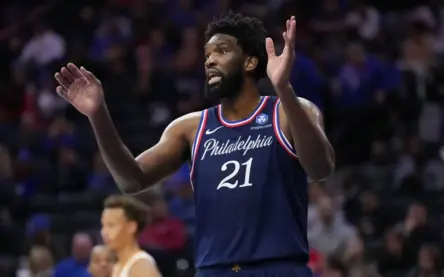
 The emotional weight on Philadelphia felt as heavy as moments when fans glance at Crickex Sign Up during a tense finish, because beyond the final score, this latest game carried deeper meaning. After more than eight months of waiting, Joel Embiid, Paul George, and Tyrese Maxey finally stepped on the court together again. But despite Embiid and George returning side by side, Maxey was once more left carrying the burden almost entirely on his own. He erupted for 44 points, 9 assists, and 7 rebounds, battling fiercely until the last possession while the other two struggled to keep pace.
Embiid finished with only 18 points, George with 16, and both had to sit out the first and second overtimes due to strict minute management as they continue recovering from lingering injuries. Embiid admitted after the game that he felt a sense of guilt, noting how much pressure Maxey had to shoulder and praising him for leading the team with such resilience. Yet when asked about his own recovery timeline or whether he could ever regain his peak form, Embiid avoided the topic entirely. Deep down, both he and George must recognize what the long series of injuries has done to their athleticism and consistency, even if they are still the marquee names on Philadelphia’s roster.
On the court, however, their impact has diminished sharply. Their combined salaries, each exceeding fifty million dollars a year, have become financial weights that limit how the franchise builds around them. Philadelphia’s management created this difficult situation themselves. Last summer, they had a rare opportunity to initiate a youth-driven rebuild, yet the organization’s analytics-obsessed leadership was convinced that keeping Embiid and Maxey together, then adding a reliable third option on the wing, would be enough to keep the Sixers in the championship conversation. That logic led to an aggressive pursuit of Paul George, who eventually signed a four-year deal worth 212 million dollars, plus a player option. Two months later, they extended Embiid again for three years and an additional 193 million. His total earnings across the next five seasons would reach a staggering 301 million, taking him through age thirty-four. Fans barely had time to dream of contention before last season shattered those hopes.
George struggled to function even as a mere third option, appearing in only 41 games and posting modest averages of 16.2 points, 5.3 rebounds, and 4.3 assists. More concerning was how detached he often looked from the Sixers’ system, never fully syncing with new teammates or the coaching staff’s tactics. Embiid’s situation was worse—just 19 games played, and statistical lows in minutes and points unseen in five years. His knee issues lingered throughout the season, and his declining mobility made him look out of step with the NBA’s increasingly fast-paced style. That injury cloud even extended to Maxey, disrupting team chemistry and rhythm, and the season spiraled into just 24 total wins, forcing Philadelphia to join the pack of teams leaning toward tanking.
This season has not offered much relief. Embiid has played only seven games, his knee discomfort still obvious, and coaching decisions must constantly align with medical restrictions. George, now five games into his own return, faces similar limits. His output has dropped to 14 points per game, ranking just sixth on the team, and his three-point accuracy sits at a shaky 31 percent. Even in moments when Embiid and George being on the floor feels like a positive sign, their muted presence in the offense continues to raise questions that supporters monitor as intently as Crickex Sign Up updates during close contests.
Still, some believe their return marks the first step toward recovery. The next task for Philly is stabilizing the starting lineup and defining a long-term rotation. If they want to climb out of ninth place in the East, Embiid and George will need to provide far more than sporadic flashes of talent. Yet there is another possibility—one the franchise may soon have to confront. Embiid and George may already be past the point where they can return to their best form, while Maxey is entering his prime with confidence and momentum. Rookie guard Jared McCain and young standout Ron Holland II have also shown signs of becoming reliable contributors, with McCain posting three games of 15-plus points in his last four outings after returning from injury.
Philadelphia’s payroll sits at around 195 million dollars this season, just seven million above the luxury tax. That gives the front office a bit of breathing room to extend the experiment with their three-star structure. But if Embiid and George continue to struggle while the younger players keep rising, this youth movement could become the catalyst for an early transformation—one that reshapes the roster sooner than expected and shifts the team toward a new identity, much like fans sensing the direction of a game while tracking trends on Crickex Sign Up.